
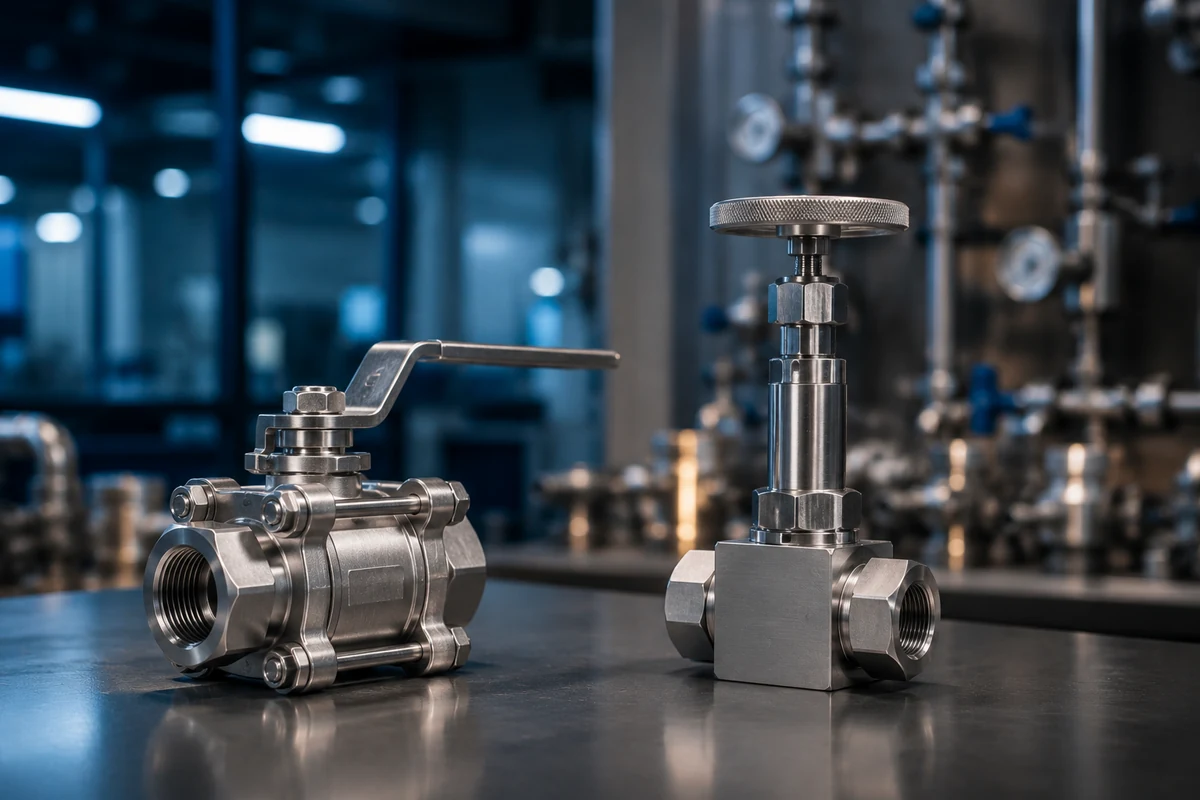
1. Fundamental Operational Differences
The primary distinction between a ball valve and a needle valve lies in the mechanism of closure and the flow path geometry:
- Ball Valves: Operate via a quarter-turn (90°) rotary movement. A spherical ball with a central cylindrical bore aligns with the flow path in the open position and rotates perpendicular to the flow in the closed position. This provides fast, visual on/off operation with minimal resistance to flow.
- Needle Valves: Operate via multi-turn linear stem travel. A finely threaded stem drives a tapered needle-point disc into a matching orifice seat. Turning the handle gradually increases or decreases the annular clearance between the needle and the seat, allowing fine regulation of flow rates.
Engineering Rule of Thumb: Ball valves are designed for positive, fast on/off isolation. Needle valves are engineered for precision flow regulation, calibration lines, and controlled pressure drop.
2. Throttling and Cavitation Considerations
One of the most frequent misapplications in fluid systems is using a standard ball valve for throttling. Partially opening a ball valve exposes the elastomeric or polymeric seat edges directly to high-velocity flow streams, causing seat erosion (wire drawing), localized turbulence, and premature seal failure.
Needle valves, conversely, are specifically designed to withstand high differential pressures across the restricted orifice. The gradual taper of the needle ensures linear flow adjustment and distributes fluid shear evenly around the seat perimeter.
3. Flow Characteristics & Pressure Drop Comparison
| Feature / Parameter | Ball Valve | Needle Valve |
|---|---|---|
| Operation Mode | Quarter-turn (90° on/off) | Multi-turn precision adjustment |
| Flow Coefficient (Cv) | High (Straight-through bore) | Low to Moderate (Restricted orifice) |
| Throttling Capability | Not recommended (seat erosion risk) | Excellent (fine metering control) |
| Actuation Speed | Rapid isolation | Gradual / Non-slamming |
| Typical Applications | Main line isolation, emergency shutdown | Gauge isolation, metering, sampling bypass |
4. Selecting the Right Valve for Your Application
When specifying between ball and needle valves in instrumentation skids and fluid distribution lines, consider the following selection criteria:
- Is precision flow control required? If fine flow regulation or calibrated dosing is necessary, specify a needle valve.
- Is minimal pressure drop critical? For main transfer lines where fluid velocity and flow volume must remain unhindered, specify a full-bore ball valve.
- Is rapid manual isolation essential? In emergency scenarios where immediate closure is required, a quarter-turn ball valve is superior.
5. Conclusion
Understanding the mechanical and hydrodynamic characteristics of ball valves versus needle valves ensures system safety, prevents cavitation damage, and maximizes the service life of fluid control equipment.