
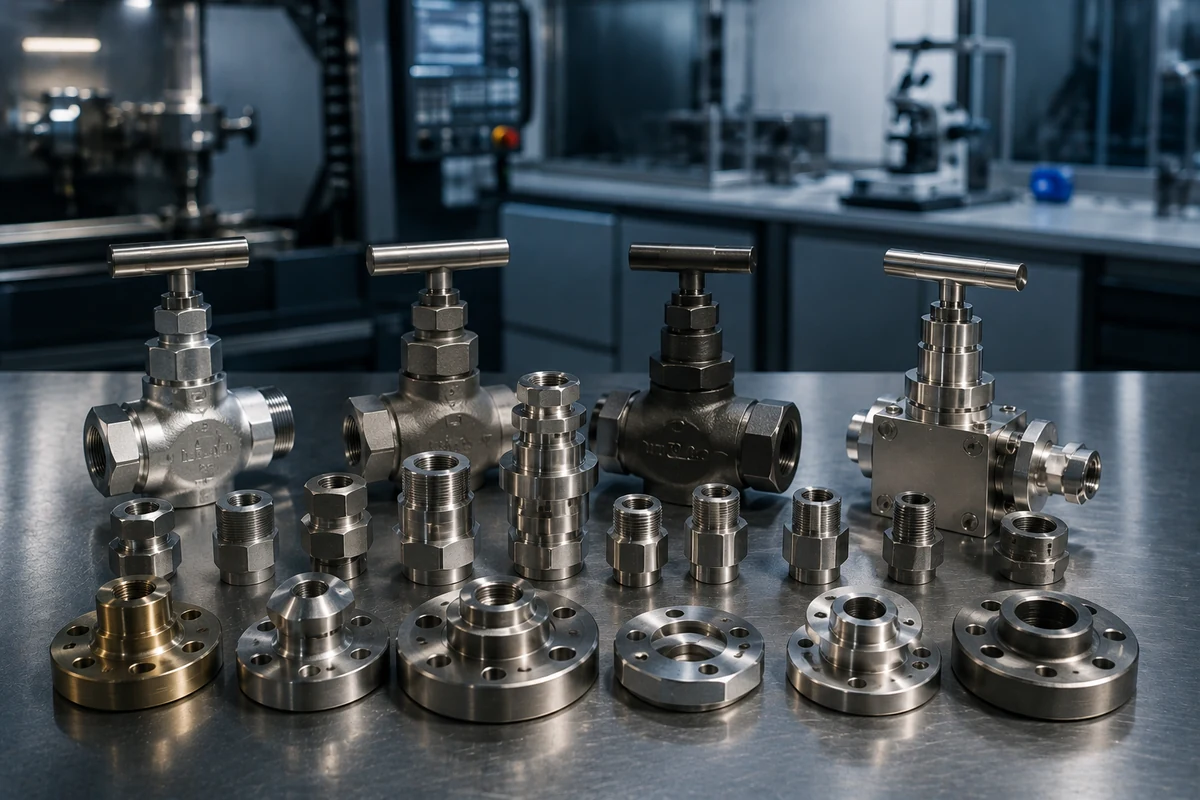
1. Stainless Steel 316 / 316L (The Industrial Workhorse)
AISI 316 is the standard material of construction for most high-pressure instrumentation valves and manifold systems:
- Composition: Iron-based austenitic stainless steel with 16–18% Chromium, 10–14% Nickel, and 2–3% Molybdenum.
- Strengths: Excellent mechanical tensile strength, outstanding machinability, cost-effectiveness, and good resistance to general atmospheric and mild chemical corrosion.
- Limitations: Susceptible to localized pitting and crevice corrosion in stagnant, high-chloride marine environments or hot concentrated acids.
2. Monel® Alloy 400 (Nickel-Copper Alloy)
Monel 400 is an engineered nickel-copper solid-solution alloy renowned for its exceptional resistance to seawater, hydrofluoric acid, and marine atmospheres:
- Composition: ~63% Nickel and ~28–34% Copper with small additions of Iron and Manganese.
- Key Applications: Marine and offshore piping, sour crude handling, hydrofluoric acid alkylation units, and salt processing facilities.
- Strengths: Virtually immune to chloride ion stress corrosion cracking and resistant to biofouling in flowing seawater.
3. Hastelloy® C-276 (Nickel-Molybdenum-Chromium Superalloy)
Hastelloy C-276 is an ultra-high-performance superalloy engineered specifically for severe chemical reduction and oxidation environments:
- Composition: High Nickel matrix with ~15–17% Molybdenum, ~14.5–16.5% Chromium, and ~3–4.5% Tungsten.
- Key Applications: Wet chlorine gas, hypochlorite solutions, hot sulfuric and hydrochloric acids, and flue-gas desulfurization (FGD) scrubbers.
- Strengths: Exceptional Pitting Resistance Equivalent Number (PREN > 45), eliminating localized pitting and crevice corrosion in hostile media.
4. Inconel® 625 (Nickel-Chromium-Molybdenum Superalloy)
Inconel 625 is an exceptionally versatile solid-solution strengthened nickel-based superalloy engineered for extreme high-temperature and severe marine environments:
- Composition: ~58% min Nickel with ~20–23% Chromium, ~8–10% Molybdenum, and ~3.15–4.15% Niobium.
- Key Applications: Sour gas (H2S / NACE MR0175 compliant), subsea manifold equipment, flare stacks, and high-temperature chemical reactor loops.
- Strengths: High tensile and creep strength up to 982°C (1800°F), outstanding fatigue resistance, and near-total immunity to chloride-induced pitting and crevice attack.
5. Metallurgy Comparison Matrix
| Alloy | Primary Base | Chloride Resistance | Acid Resistance | Relative Cost |
|---|---|---|---|---|
| SS316 / 316L | Iron-Chromium-Nickel | Moderate (ambient chloride) | Good (mild acids) | Standard / Baseline |
| Monel 400 | Nickel-Copper (Ni-Cu) | Excellent (marine / seawater) | Outstanding (HF / organic) | Moderate to High |
| Hastelloy C-276 | Nickel-Moly-Chrome | Exceptional (zero stress cracking) | Extreme (hot HCl, H2SO4, Cl2) | High Premium |
| Inconel 625 | Nickel-Chromium-Moly | Exceptional (subsea / sour gas) | Extreme (sour gas H2S & acids) | High Premium |
| Titanium (Gr. 2) | Unalloyed Titanium | Immune to ambient chloride | Excellent in oxidizing media | High Premium |
6. Conclusion
Balancing initial procurement cost against lifecycle integrity requires thorough evaluation of media composition, operating temperature, chloride concentration, and pH levels.