
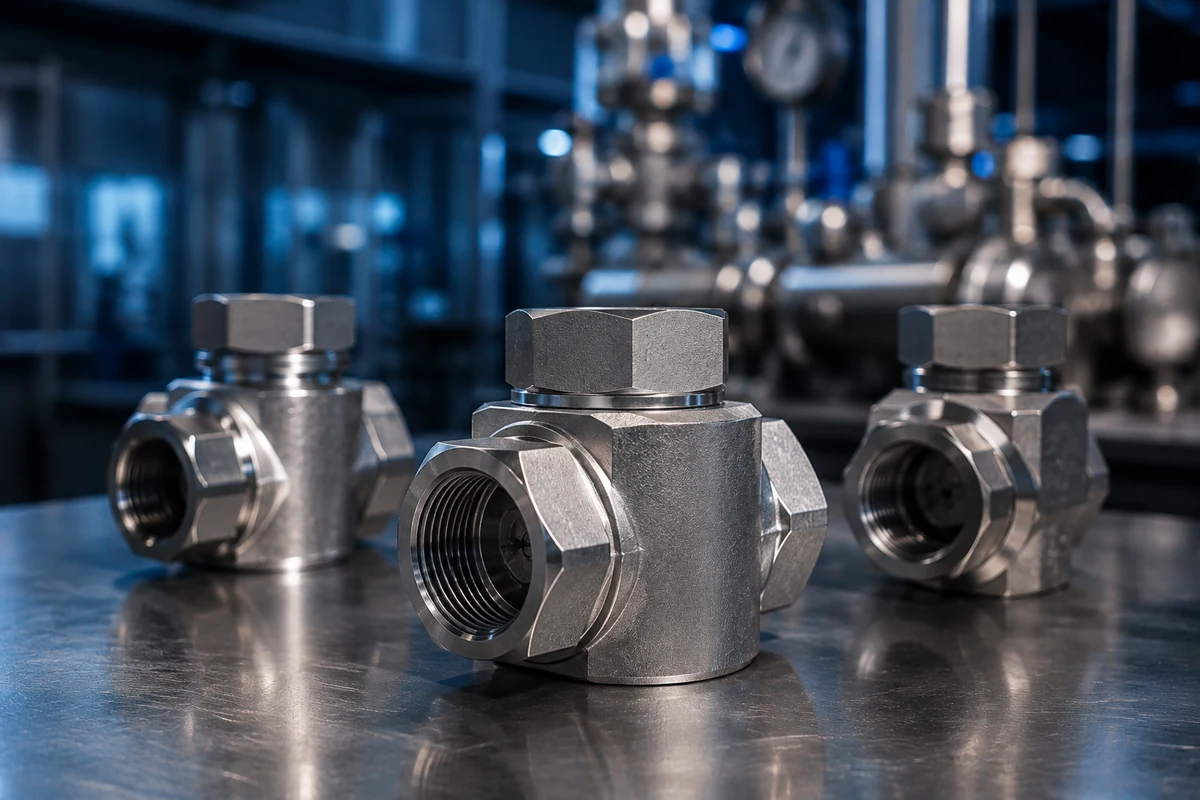
1. How a Check Valve Operates
Unlike manually operated ball or needle valves, check valves rely entirely on line pressure differential to function. The internal mechanism typically features a spring-loaded poppet, ball, or piston held against an elastomeric or metal-to-metal seat.
- Forward Flow: When the upstream pressure exceeds the spring resistance (cracking pressure), the closure element is pushed off the seat, allowing medium to pass.
- Reverse Flow / Backpressure: If downstream pressure rises or upstream flow ceases, the spring combined with reverse fluid pressure immediately pushes the element back onto the seat, ensuring zero backflow.
Key Parameter — Cracking Pressure: The minimum upstream differential pressure required to initiate flow through the check valve. Common spring ratings range from 1/3 PSI up to 25 PSI or higher depending on hydraulic design requirements.
2. Common Check Valve Configurations
In instrumentation and industrial process circuits, two main internal geometries predominate:
- Poppet Check Valves: Feature a guided poppet disc with an elastomeric O-ring or precision metal face. These provide excellent reseat sealing and rapid shut-off response.
- Ball Check Valves: Utilize a free-floating or spring-loaded spherical ball. Highly durable in high-pressure or slurry conditions where guided mechanisms might bind.
3. Critical Industrial Applications
Check valves serve as primary protective devices across demanding fluid circuits:
- Pump & Compressor Discharge Protection: Prevents high downstream system pressure from driving back into pumps during shutdown, eliminating reverse rotation and mechanical damage.
- Chemical Injection Lines: Prevents main process stream fluids from migrating backwards into chemical dosing skids.
- Hydraulic Power Units (HPUs): Maintains accumulator charge pressure and isolates distinct pressure circuits.
4. Conclusion
Proper selection of check valve cracking pressure, body metallurgy (SS316, Monel, Hastelloy), and seat material is crucial to prevent chatter, premature spring fatigue, and system contamination.