
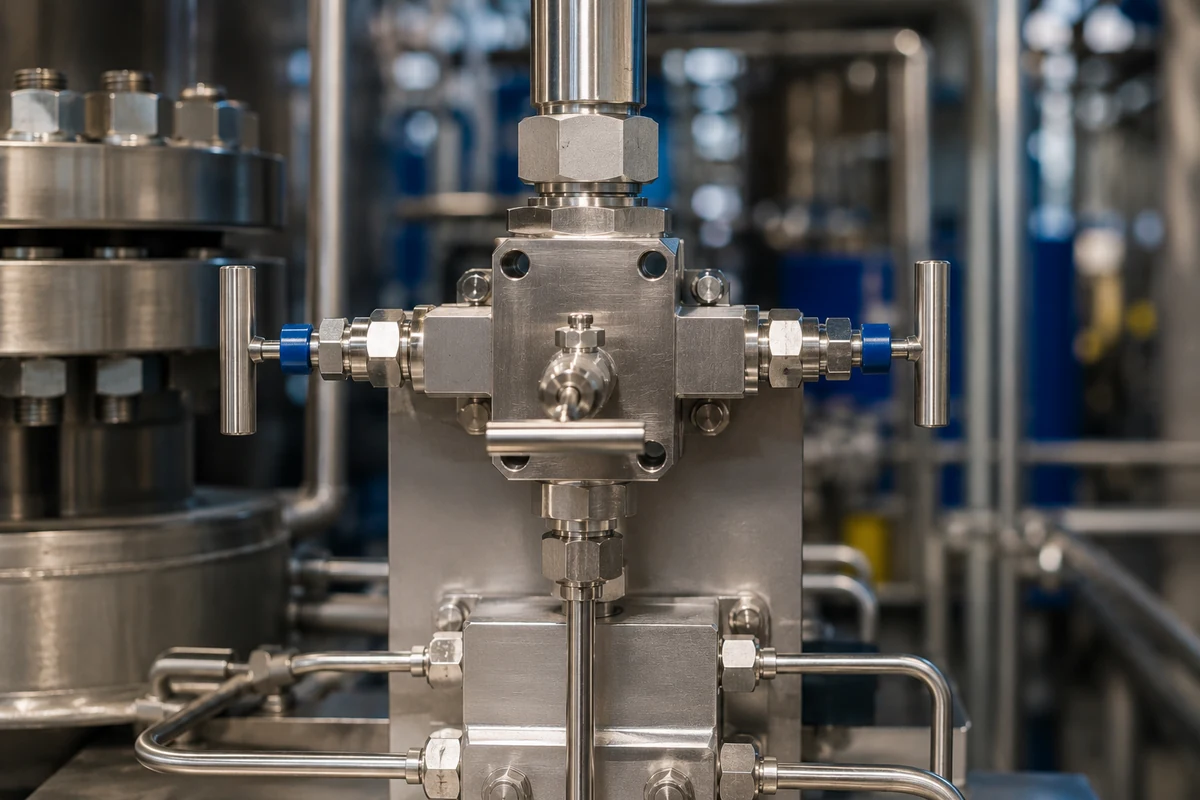
1. The DBB Working Principle
A Double Block and Bleed arrangement consists of two sequential in-line isolation valves (the "blocks") with an intermediate bleed or vent valve located in the cavity between them.
- Primary Block Valve: Isolates the high-pressure upstream process fluid.
- Secondary Block Valve: Provides secondary barrier protection towards the downstream transmitter or service tap.
- Bleed Valve: Vents the trapped fluid volume between the two blocks. If the primary block experiences any seat leakage, fluid escapes safely through the bleed port rather than pressurizing the downstream instrument.
Key Safety Advantage: Opening the bleed valve provides immediate visual or monitored proof that the upstream isolation barrier is 100% leak-tight before technicians disconnect instruments.
2. Traditional Hook-ups vs. Integral Monoflange / DBB Valves
Historically, DBB isolation required welding or bolting three separate valves, piping spools, and intermediate flanges together. Modern integral DBB valves integrate all three functions into a single forged body:
- Leak Path Reduction: Eliminates multiple flanged gasket interfaces, drastically reducing potential fugitive emission points.
- Weight & Space Savings: Integral designs achieve up to 70% reduction in weight and installation envelope, critical for offshore topsides and compact skid packages.
- Reduced Vibration Stress: Shorter cantilever length reduces bending moments on piping nozzles caused by pipeline vibration.
3. Typical DBB Valve Configurations
DBB assemblies are produced in several valve combinations depending on pressure class, media cleanliness, and shut-off speed requirements:
- Ball-Needle-Ball (Modular): Two quarter-turn ball valves for primary/secondary block with a central needle valve for venting.
- Needle-Needle-Needle (Monoflange): Compact needle valves ideal for clean gas, sampling, and transmitter static pressure tapping.
4. Conclusion
Specifying integral Double Block & Bleed valves enhances plant safety, simplifies maintenance workflows, and ensures rigorous compliance with piping isolation standards.